
How to Selecting High-Performance Walking Ball
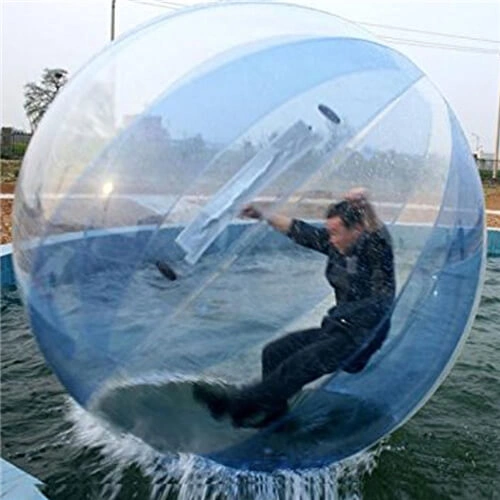
Walking ball (also known as water balls or water walking balls) are pressurized inflatable structures that demand rigorous engineering standards. Failure in material integrity, sealing mechanisms, or stress distribution can lead to rapid deflation and safety hazards. This article outlines the technical parameters for selecting a walking ball, focusing on material composition, zipper integrity, and structural reinforcement.
- Material Analysis: PVC vs. TPU
The membrane material determines tensile strength, environmental resistance, and user safety. The industry utilizes two primary polymers: polyvinyl chloride (PVC) and thermoplastic polyurethane (TPU).
PVC (Polyvinyl Chloride):
Properties: PVC is cost-effective but exhibits lower mechanical performance. Standard thicknesses range from 0.8mm to 1.0mm. PVC has moderate abrasion resistance and can become brittle in temperatures below 0°C. Over time, plasticizers may migrate, causing the material to stiffen and crack.
Safety: Lower-grade PVC may emit volatile organic compounds (VOCs), resulting in odors that can affect air quality inside the sealed sphere.
Application: Suitable for low-frequency, budget-constrained operations in moderate climates.
TPU (Thermoplastic Polyurethane):
Properties: TPU is the premium standard for commercial use. It offers superior tensile strength (often >4000 psi), tear resistance, and hydrolysis resistance. TPU remains flexible in sub-zero temperatures and possesses excellent UV stability, resisting yellowing and degradation.
Safety: TPU is odorless and eco-friendly, ensuring a safer breathing environment for users. Its higher elasticity allows for better impact absorption.
Application: Recommended for high-traffic commercial rentals, varied weather conditions, and operators prioritizing longevity and safety compliance.
Technical Recommendation: For commercial durability, specify 1.0mm TPU. If using PVC, ensure it is phthalate-free and rated for the expected temperature range.
- Zipper Systems: Supplier Quality and Installation
The zipper is the critical failure point in any airtight inflatable. It must maintain a hermetic seal under dynamic loads and internal pressure.
Supplier Selection:
Generic zippers often suffer from slider deformation, tooth misalignment, and seal degradation. Technical buyers should specify zippers from established manufacturers with proven airtight technology.
TIZIP (Germany) is widely recognized as the industry benchmark. Their MasterSeal technology provides consistent air retention and high resistance to pressure differentials. Using certified suppliers reduces the risk of catastrophic zipper blowouts.
Technical Specifications:
Ensure the zipper is rated specifically for airtight applications, not merely waterproof.
Installation Integrity: The zipper tape must be heat-welded to the ball material with precise temperature control. Delamination at the zipper tape is a common defect in poorly manufactured units. Verify that the manufacturer employs quality control checks for weld strength at the zipper interface.
Maintenance: High-quality zippers require regular lubrication with silicone-based agents to maintain seal flexibility and slider function.
- Reinforcement in Key Stress Areas
Uniform material thickness is insufficient for high-impact zones. Effective design incorporates targeted reinforcement to distribute mechanical loads and prevent tear propagation.
Zipper Reinforcement:
The zipper area experiences significant torque during rolling. Reinforcement patches should be applied over the zipper tape ends to prevent peeling.
An external protective flap or abrasion strip over the zipper reduces direct contact with the ground, minimizing wear on the sealing mechanism.
Handle and Strap Anchoring:
Internal handles give user stability while creating concentrated stress areas. The handle attachment must include multi-layered reinforcing patches.
Sandwich Construction: During heat welding, the webbing should be confined between layers of material rather than installed on the surface. This spreads tensile pressures across a larger region, reducing tear-out during abrupt user movement.
Seam Engineering and Abrasion Zones:
Seams should be made by high-frequency welding or hot-air welding. Overlay strips are beneficial for critical seams because they ensure that the seam strength surpasses the tensile strength of the underlying material.
For land use, an equatorial abrasion strip is advised to protect the main membrane from ground contact.
Conclusion and Selection Checklist
To ensure operational safety and maximize return on investment, evaluate walking balls against the following technical criteria:
- Material: Prioritize TPU for commercial use due to superior tensile strength, temperature flexibility, and odorless composition.
- Zipper: Mandate TIZIP or equivalent airtight zippers and verify heat-welding quality at the tape interface.
- Reinforcement: Inspect for multi-layer patches at handles, zipper protection flaps, and robust seam overlays.
By adhering to these technical standards, operators can mitigate equipment failure, reduce maintenance downtime, and ensure a safe environment for users.